With the holiday season quickly approaching, I figured I would share a few holiday gift ideas for the car enthusiast in your life — or, let's face it, probably for yourself. (Note that some links may be affiliate links, which means I will earn a commission if you purchase a product at no extra cost to you.)

2025 Holiday Gift Guide for Car Enthusiasts

LED Garage Lights

The first thing on this list are LED garage lights. A set of two is only about $22 on Amazon. The 200-watt lights are super bright and easy to install; you just screw them into your normal light bulb socket, so there’s no rewiring required. You can even adjust the panels so you can better illuminate your garage or work area. We have two in our windowless garage, and it’s almost like daylight in there with them on.

Drip Pans

Next up is something that any classic car owner would love to have, especially if they have multiple cars in their collection. Automotive drip pans tend to be expensive — about $25 to $30 each — and that cost can add up if you have a few chronically leaking four-wheeled children in the garage. This package of 12 sheet pans from Webstaurantstore is about $85, and including ground shipping, that works out to just about $10 each. They measure 18 inches by 26 inches and have a decent lip around the edge, so they hold plenty of fluids. We use these in the storage unit, and they keep the floor dry. And you can't beat the price.

Chemical Guys 14-Piece Detailing Kit

Another thing that all car enthusiasts need is detailing products. We have several in our stash, but this 14-piece Chemical Guys set is about $82 on Amazon right now and includes everything you need to get the exterior of your car spotless. It includes a bucket with a grit guard to trip dirt and contaminants so that they don’t end up causing swirls and scratches on your car’s paint, as well as a microfiber wash mitt and a foam spray gun. It also comes with a snow foam wash fluid, wax, wheel cleaner and brush, window cleaner, a tire shine protectant spray and applicator, and towels.

Windshield Wow

Next up is something that we use for all the cars in our fleet, and its name almost sounds like some gimmicky As Seen On TV product (remember ShamWow?). The Windshield Wow Pro Kit is about $130 with free shipping, and I think it is worth every penny. It makes cleaning both the inside and outside of your windshield easy, especially down at the bottom of the windshield where it meets the dashboard. Simply attach a couple of microfiber cloths (which can be tossed into the washing machine after for reuse) to the strong magnets and place them on either side of the windshield glass. Then, you just slide the Windshield Wow back and forth, cleaning both sides of the windshield at the same time. This kit also includes a small can of Sprayway glass cleaner, which is an excellent foaming cleaner that does run and drip onto your dashboard or anything like that.

So, that’s it, my list of a few holiday gift ideas for the car enthusiast in your life or, let’s face it, probably yourself.

Watch the YouTube Video Here

Purus fermentum purus, enim faucibus diam amet ultricies ornare enim. Eu, sed vel nunc enim, sollicitudin vitae ut. Dolor augue congue fermentum euismod donec. Leo lectus...
Join to access

One of the little things that has always bugged me while driving Diamond has been the lack of a place to put things like my wallet or a travel mug. I’ve had to hold things in between my legs or let them either fall in between or slide across the seats — none of which is ideal. So, I decided to put an end to that and craft up a center console with a tray and a couple of cupholders.

1967 Plymouth Fury VIP center console DIY

Making a Template

I started by grabbing an old cardboard box and cutting it into a more manageable size. I was undecided on how big I wanted the center console to be, but once I started to place the cardboard down over the transmission tunnel, I realized I didn’t want to block the controls for the floor vents, which sit at the bottom of the dashboard. The one piece of cardboard proved to be enough for the general shape (though later, I did make the shape more square rather than angled so that it would be easier to cut out of wood). I cut out more cardboard pieces for the front and back of the console and taped everything together. 

1967 Plymouth Fury VIP center console build template

Once everything looked good enough, I took the template home and made a cleaner version to fix up some of the rough cuts. I took it back for a test fit and made a few more adjustments, and then I was ready to really start working.

Putting the Center Console Together

I chose half-inch plywood for this project for its price and rigidity, and cut one of those 2-foot-by-4-foot “handi panels” with a jigsaw since there were curves in the design. I followed that up by using an orbital sander and tapered the corners some so that they weren’t square. Using wood glue and brad nails, I secured the pieces together. After the wood glue was dry, I cut out and sewed some faux leather fabric that would be the cover for the center console. 

1967 Plymouth Fury VIP center console build

I designed a tray that would act as a place to put my phone and wallet on 3-D modeling software and had my husband print it out on the 3-D printer, which took probably longer than a day. Once it was printed, I painted the tray black with a gold rim (using some of the leftover black wheel paint from when I worked on Diamond’s new wheels), and I also painted some sticky-back cork black to place on the inside to create a more grippy surface. After spraying some adhesive on the wood and inside of the fabric, I placed the fabric on the console and then added the tray and cupholders (on which I had also painted the rims gold). 

The end result may not be the most perfect thing, as some of the imperfections in the wood show through the fabric. (I originally thought of using some quilt batting to make it a bit of a “soft touch” surface but apparently didn’t think of that while cutting out the fabric and had no extra allowance for it, but that would’ve helped conceal the imperfections.) But overall, I’m really pleased with how everything turned out. The colors work well with the rest of Diamond’s interior, and the gold paint ties in nicely with the VIP emblems and accents. And now that I have some leftover plywood to play with, I’ll work on putting another console together for Olivia to replace the cheap plastic one that’s currently in her.

Watch the YouTube Video Here

Featured Tools, Parts, and Materials

(Some links may be affiliate links, which means I will earn a commission if you purchase a product at no extra cost to you.)

One of the things I’ve long debated on for Diamond was what wheels to get, and I spent countless hours browsing websites and looking at pictures of C-bodies on forums. I knew I wanted to get larger wheels so that someday I can do a disc brake conversion (you can’t properly do a conversion with the stock 14-inch wheels), but I didn’t know how big I wanted to go. 

1967 Plymouth Fury VIP with Chrysler police wheels

At some point late last year, I decided on grabbing five 15-inch Chrysler cop wheels that my father had stashed away. And so while I was home for Thanksgiving, I picked them up and brought them home.

1967 Plymouth Fury VIP

Before with the stock 14-inch wheels.

Three of the wheels were in decent shape, though they all had a bit of surface rust and some imperfections around the surface that I could just attribute to age and being used. One was bent badly in one spot of the rim — which I tried to repair, but it proved to be difficult because of the size and complexity of the bend — and another wheel somehow had bad curb rash all around the rim. That’s the one I ended up fixing with a grinding wheel and a flap disc on the angle grinder.

I tried all sorts of things to strip the wheels, and in hindsight, it would’ve been easier to just take them to a shop for blasting or using caustic aircraft-grade paint stripper. I tried blasting with two different blast medias, but both took so long to get any good progress. I threw a wire cup brush on the angle grinder and used that at one point, but I got tired of getting stabbed a million times by the little wires and then finding them in my clothes and around the house for a week later. I also tried letting the wheels soak with some EasyOff for a day; this worked a tiny bit after using the 0% nozzle on the pressure washer to wash it off, but not enough. 

Finally, I found some paint/rust stripping grinder wheels, which worked the best out of all of the methods, but they couldn’t reach the nooks and crannies of the wheels and wore through really fast. After I got as much off as I could, I went back to the wire cup brush to get the rest of the bits off. The stripping process took months to do, off and on. That’s also partially due to rainy weather, hot and humid weather, life, and my full-time job getting in the way of things. But oh well.

Chrysler police wheels primered

Next up, I hit the wheels with some self-etching primer, then filler primer. With the filler primer, I flooded some of the spots that had deeper imperfections, knowing that I was going to sand the wheels anyway. After everything looked good enough for paint, I got the air hose to blow out most of the primer dust and ran a tack cloth over them to clean off the rest.

I then hit them with black wheel paint, which actually created a more textured surface than I’d like. So, I sanded the faces down with fine-grit sandpaper (400 for the “bad” stuff, then 600, 800, and finally 1,500 grit) to smooth them out and fix some runs in the paint before using the tack cloth on them again and spraying on a couple of coats of gloss clear. 

Pro tip: Harbor Freight’s tack cloths are better than the Bondo brand ones. When you cut the Bondo brand tack cloths into pieces (I cut each cloth into four pieces — one for each wheel), the edges of the cloth fray and leave bits and pieces everywhere. Harbor Freight’s tack cloths don’t do that. And they’re cheaper.

1967 Plymouth Fury VIP with Chrysler police wheels

When all was dry a couple of days later, I made the trek over to the tire shop to get the wheels and new tires installed. I went with Cooper Cobra Radial GTs, P235/70-R15. These were the tires that were on her when we got her, and I prefer the white lettering on the sidewalls. After getting back home, I put on the NOS Chrysler center caps that I bought at the Chrysler swap meet in Indianapolis in February, and all was finally completed.

I'm really happy with how these wheels turned out, especially after all the time I spent refurbishing them. I love this look on Diamond, and I think it adds to her sort of hot rod appeal.

Watch the YouTube Video Here

Featured Tools and Parts

(Some links may be affiliate links, which means I will earn a commission if you purchase a product at no extra cost to you.)

One of the things I like about living in Indiana is that a front license plate isn’t required. Now, don’t get me wrong — I don’t mind when the front license plate area is actually part of the bumper, like it is on Diamond and Olivia, not something just tacked onto the front. But Serenity’s was just that; a dealership in Serenity’s past life (she was previously in Virginia and Ohio after all) drilled half-inch holes in her front bumper to mount a license plate holder. With no front plate and me liking how the car looks without the holder, there’s just no need for it. And after almost three years of owning Serenity, I decided it was finally time to take the dang thing off.

Serenity, 2013 Subaru BRZ license plate bracket removed

The problem with this plate holder was that I couldn’t just take a 10-mm socket and ratchet the bolts out. Instead, it had rubber grommet things on the back of the bumper that would just spin with the bolt, and they were inaccessible from the bottom and top. So, this process was more complicated than it should’ve been — I had to remove the front bumper.

Serenity, 2013 Subaru BRZ license plate bracket

Removing the Front Bumper

To start, I drove Serenity up onto the ramps so that I could get better access to the bolts on the bottom of the bumper, chocked her rear wheels, and popped open the hood. Next, I removed the three trim retainers in the front of the wheel wells on each side, as well as the side marker lights as there is a retainer behind it, as well. The side marker light popped out after pushing in a little metal clip with a flat-head screwdriver; then, rotate the light to pop the bulb out.

Once all of those were out, I moved to the bottom of the bumper. There are two 10-mm bolts down there, plus what is supposed to be seven of the trim retainers, but somehow Serenity only had three. Up at the top of the front bumper are five 10-mm bolts and two trim retainers. After all were out, I just popped the bumper off. The connectors to the fog lights were still connected, so I just pushed down on the tab on the connectors and slid the pieces apart, though that took a little bit since it didn’t want to come apart while I was trying to prop up the bumper at the same time.

Removing the Front License Plate Holder

After the bumper was off, it was time to get the plate holder off. The rubber grommet things proved to be a little challenging, but in hindsight, they really shouldn’t have been. I tried needle nose pliers to hold it in place while trying to ratchet the bolt off. That didn’t work, of course.

I then remembered: Vice grips are a thing. So, I dug them out of the toolbox and snapped them onto the grommet, and wouldn’t you know, they worked. The license plate holder fell off, I popped the grommets out of the holes (those needle nose pliers finally became useful here), put the front bumper back on, and all was right in the world.

Serenity, 2013 Subaru BRZ license plate bracket removed and holes plugged

Filling the Holes

Well, almost everything was right in the world. Removing the license plate holder left behind two half-inch holes in the bumper. This required a trip to my local Ace Hardware to grab some bumper plugs — which, oddly, the half-inch plugs wouldn’t fit, but 7/16-inch ones did (for anyone who is wondering, they’re called “nylon hole plugs”). I popped them into the holes, and wa-la. Now, all was right in the world.

Watch the YouTube Video Here

Something I always like to do once in a while is go shopping, and one of my favorite types of retail therapy is tool shopping, because well, what gearhead doesn’t have enough tools on their workbench? Since the weather has been pretty crappy lately — 8 1/2 inches of rain the past week or so — and I haven’t been able to head out and work on the cars as a result, I figured I would share four tools I’ve bought recently.

(Just a note that this is not a sponsored post or anything; I’m just sharing tools. That being said, some links may be affiliate links, which means I will earn a commission if you purchase a product at no extra cost to you.)

Braun 845 Lumen Rechargeable LED Underhood Light

Braun 845 Lumen Rechargeable LED Underhood Light

This is perhaps one of my most favorite things I’ve purchased for using in the garage — and outside of it, such as during a power outage. This LED underhood light has magnets on both ends that allow you to prop it in between two metal surfaces, such as a car’s radiator core support and hood, as well as hooks on each end that let you hang it from the hood or something else. The hooks make storage a bit easier, too, as you can just hang the light out of the way. 

The light has two brightness settings, and it recharges fairly quickly via a regular 120-volt outlet power cable or a 12-volt cigarette lighter cable. It stays illuminated for quite a while, too, for up to about seven hours — useful for a midnight oil change.

Interestingly, this is also the only thing on this list that I’ve actually had the chance to really use so far.  

Hercules 3/8-inch Cordless Extended-Reach Ratchet

Hercules 3/8-inch Cordless Extended-Reach Ratchet

When you’re working in a tight space with no room to swing a ratchet wrench handle, it can be super frustrating. I think I still have PTSD from when I had zero room to work in while replacing Diamond’s engine mounts and could only move the wrench handle like a quarter-inch at a time. 

I have no idea why I haven’t bought one of these before, but I feel as though this cordless ratchet will solve some frustrations and may become one of my favorite tools. It has an extended reach, too, which will probably come in handy for those extra-hard-to-reach places, as well as up to 40 foot-pounds of torque to help loosen up stubborn rusty bolts. Unfortunately if you don’t already have a 12-volt battery and a charger, you’ll have to be like me and spend a bit more money to buy them separately.

Titanium Easy-Flux 125-Amp Flux Core Welder

Titanium Easy-Flux 125-Amp Flux Core Welder

Since I want to become a bit more self-sufficient in getting things done on the cars, I need to learn how to fabricate things — which means teaching myself how to weld. I haven’t welded since I was in a materials and processes class in college for the mechanical engineering part of my degree, and that was only for a lab class in which I just tacked a couple of welds onto two pieces of metal to hold them together.

Last year around the holidays, Harbor Freight had a sale for the Easy-Flux 125-amp flux core welder, and so I picked it up for about $100, along with a pair of welding gloves and a Chicago Electric auto-dimming welding helmet. The welder is portable and fairly lightweight — only about 15 pounds — and it doesn’t require any shielding gas, which is something I don’t feel like dealing with anyway. Though I’ve read that flux core welding can be a bit of a hot process (more so than MIG welding), I think it’ll work just fine for my needs.

Eastwood PCS-250 Powder Coating Gun

Eastwood PCS-250 Powder Coating Gun and Benchtop Oven

Sometimes advertisements get the best of me, and that’s what happened when I bought this powder coating setup from Eastwood. I saw their PCS-250 powder coating gun and benchtop oven were on sale through a social media ad and made an impulse purchase, so I guess their ad targeting was dead-on. 

The powder coating gun uses a 120-volt household outlet and has dual-voltage settings; the lower setting can be used for regular projects and the higher setting for larger projects. While the oven isn’t big enough to stick a wheel inside, it has plenty of room, which is fine since I will probably only be powder coating smaller things like brackets anyway. It also can be set for up to 400 degrees Fahrenheit and has a timer for up to 60 minutes.

Eastwood PCS-250 Powder Coating Benchtop Oven

I do need to grab some paint powder (so if anyone knows where I can find a nice pink or rose gold, let me know), but other than that and finding a spot in the garage for the oven, I should be good to go. I can’t wait to pair this with the welder and my sandblasters.

If anyone has any tips and tricks for using a flux core welder or a powder coating gun, feel free to share them.

Watch the YouTube Video Here

When I got bodywork done on Diamond last year, the shop didn’t install new seals all around. I didn’t mind it since parts can be difficult to source for a 1967 Plymouth VIP, but it was something that needed to be done. And when Diamond was in a (different) shop for the radiator work recently, she sat outside in the rain a few times, and water ended up inside the trunk. So, I figured it was finally time to put on the door seals and trunk weatherstripping. 

1967 Plymouth Fury VIP door seal installation

Installing the Front Door Seals

Late last year, I ordered some door seals from Dante’s Mopar Parts (this isn’t a sponsored post or anything; that’s just where I got them from). They took a few weeks to arrive since they’re made to order, which was fine since I wasn’t in any sort of rush. I installed the seals for the rear doors soon after they arrived, but I never got around to putting on the ones for the front doors. 

The front door seals were a little more challenging than I remember the rear ones being, and it ended up being a bit of a learning experience, especially on the driver’s side as that’s the one I did first. The clips in the rubber seal didn’t want to stay in the holes in the door and would pop out, and a couple of times, they popped out of the seal but stayed in the door, requiring me to grab a pair of pliers to (carefully) pull them out and wrestle them back into the seal. It was also difficult to see the holes along the bottom of the door, as well as the holes on the hinge side of the passenger door since I couldn’t open it all the way due to space constraints.

1967 Plymouth Fury VIP door seal installation

A portion of the wide rubber end that goes on the hinge side of the door is supposed to tuck underneath the interior door panel, too. Anyone who knows me knows I hate dealing with doors, and of course I wanted to avoid disassembling things. To work around it, I trimmed off the corner that goes up against the door panel, and while that part of the door seals might not be perfect, it works, and that’s all that matters to me. 

1967 Plymouth Fury VIP door seal installation

The ends of the front door seals also need to be cemented on — a step mentioned in the service manual and not required for the rear seals. The wide rubber end also seems to require fasteners, but Diamond didn’t have any (if she did, they were lost during the bodywork) and the holes in the rubber didn’t align with the ones in the doors. I used black 3M weatherstrip adhesive on the ends, and then put painter’s tape on to hold them in place while the adhesive dried. The next day, they were good to go.

1967 Plymouth Fury VIP trunk weatherstripping installation

Installing the Trunk Weatherstripping

Putting the weatherstripping on the trunk oddly proved to be the easier task, though it was messier. The weatherstrip adhesive likes to ooze out of the tube a little; thankfully I had some paper towels available, so I put one down to rest the tube on when I wasn’t handling it. The adhesive also made a mess on my hands throughout the installation. (By the way, nail polish remover works great for getting that stuff off, though it’ll dry out your skin pretty good.)

1967 Plymouth Fury VIP trunk weatherstripping installation

The weatherstripping I got from Detroit Muscle Technologies (again, not a sponsored post) at the Chrysler swap meet in Indianapolis a few weeks ago works for a variety of Mopar body styles, and it was super long to accommodate C-body trunks. It has a V-shaped channel that faces outward from the car (so, not pointing toward the inside of the trunk), and there’s a flat side and a side with a little bit of a ridge on it. The flat side is what touches the trunk’s surface. 

Starting from the lock striker, I worked around the trunk in sections, squeezing out a line of adhesive, laying the weatherstripping on top, and taping it down. I peeled off a few pieces of the painter’s tape at a time to make it easier to grab-and-go while trying to hold the weatherstripping in place after putting the adhesive down. 

1967 Plymouth Fury VIP trunk weatherstripping

Once I made it all the way around, I let the adhesive dry overnight with the trunk lid open, and I came back to the storage unit the next day to remove the tape and snip off the excess weatherstripping. Though there are a couple of areas where the weatherstripping ended up being a little wavy, I’m pleased with how it turned out and am glad that I won’t be getting any more water inside the trunk should Diamond be stuck out in the rain again.

Watch the YouTube Video Here

One of the things I’ve always wanted to do since buying Serenity is install a different radio head unit, as the stock Subaru touchscreen is horrendous. It’s not always responsive, and when it does respond, it lags. I’ve considered just getting an aftermarket head unit with Apple CarPlay, but there aren’t many available that get decent reviews, have at least a volume knob, and don’t look like some aftermarket thing stuck onto the dash. 

2013 Subaru BRZ radio head unit

I also have come to hate touchscreens in cars. When they first came out, I thought they were neat, but then automakers started adding more and more basic controls into the touchscreen menus. Every time I get behind the wheel of a new car for my “big girl” job, I almost automatically despise it because of the touchscreen. Why can’t I have a volume knob? A skip button? Why do I have to dig through multiple menus just to figure out how to adjust the steering wheel position? (And no, I will not interrupt my favorite song or podcast to use voice controls for something that should be so simple.) Part of the beauty of a car like Serenity is being able to change a climate setting or turn on seat heaters without even looking at the controls.

So, I wondered if the first-generation Subaru BRZ ever had a non-touchscreen radio as OEM equipment and consulted the internet to see. I found out that the BRZ didn’t offer one, but its twin, the Scion FR-S, did. I also discovered that it’s a plug-and-play unit that doesn’t require any rewiring. $65 later, I had one on the way from an eBay seller.

Scion FR-S Pioneer radio head unit installed

Installing the Radio Head Unit

The installation was fairly simple — possibly one of the easiest things I’ve done on a car recently besides an oil change. All you need is a trim removal tool, a 10-mm socket (preferably with an extension), and a Phillips-head screwdriver. And even though you probably don’t have to, I disconnected the battery’s negative terminal before starting since I’m paranoid about messing up a newer vehicle’s electronics. 

I carefully popped the surrounding trim piece off, making sure to not break any of the five clips (two on each side plus one in the middle of the bottom). Then, I removed the four bolts that hold the brackets in place, slid out the radio, and disconnected the wires. I also had to move the original brackets onto the new head unit as it didn’t come with any.

Not all of the BRZ’s wires are used in this swap; two green wires on each side, as well as one with a white clip on the right side, don’t have connections on the FR-S unit, so I just let them be after connecting the wires to the new radio. (They're probably used for the satellite navigation system, which the Scion unit doesn't have.) The rest of the installation process is just the reverse of removal.

Once the new radio head unit was installed, I turned it on to see how it worked, and it worked perfectly. It’s nice having actual button controls instead of a touchscreen that doesn’t always respond when trying to skip songs or trying to change radio stations. The next step will be figuring out how to remove or cover up the “Scion” logo at the top of the radio.

Watch the YouTube Video Here

At some point last year, Olivia’s rubber shift boot ripped, leaving an opening for dirt to end up in the shift mechanism below. Of course, I bought a replacement and installed it prior to heading to the Louisville stop of the Hot Rod Power Tour, but the new boot proved to be too stiff; no matter where I placed the top edge of it (where it attaches to the shift lever), it would cause the shifter to pop out of gear. This caught me by surprise once while turning left into a gas station, when the shifter popped out of first gear while going through the busy intersection, and I had to figure out how to get it to stay in gear so that I could move out of the way of traffic. It then ripped once I got going again. $50 down the drain.

Dodge truck shift boot DIY

Since then, I’ve been driving around with a ripped boot, but I’ve finally decided to do something about it and craft up a new one. And since it’s still a bit cold outside, I figured this is a good time to knock out a project that doesn’t involve freezing my fingers off in the garage.

Ripped Dodge truck shift boot

Making the Shift Boot

I purchased some brown faux leather fabric, interfacing material (which adds some stiffness and stability as the fabric was more flimsy and lightweight than I wanted), and black heavy-duty upholstery thread and ventured over to the storage unit to grab the ripped shift boot off Olivia.

The first step was to make paper templates so that I could figure out how to cut the fabric. I decided to use the bottom of the rubber shift boot in the final product, as it would add some stability and because the bezel plate has curved edges that need something to sit on top of instead of resting directly on the transmission tunnel. I measured along the sides of the inner part of the shift boot, which worked out to be 3 inches for one side and about 3 ¾ inches for the other. On a couple pieces of paper, I measured 2 inches up from the edge of the paper and then drew my lines for the aforementioned measurements. Next, I folded the paper to find the halfway points for those lines, measured 5 inches above them (about how tall I decided I wanted the shift boot to be), and drew triangles out of those points. I then cut out the triangles.

Next was to prep the fabric. I traced the templates twice onto the fabric and the interfacing material, so that I had eight pieces total (a piece of fabric and interfacing for each of the four sides). For the fabric, I actually made the pieces a little bigger for the seam allowance — I added a quarter-inch on the sides that would be sewn. I then ironed the rough side of the interfacing to the wrong side of the fabric to bond them together.

I’ll admit that I actually kind of suck at sewing, so I broke out my sewing machine. This allowed me to at least have even stitches for this project and made it so sewing wouldn’t take ages to complete, like it would if I decided to hand-sew everything together. I laid out the four pieces and sewed the seams together, with the right sides of the pieces facing each other, then hand-sewed the pieces at the top to create a sort of hem. (If this were a fabric like cotton, I would’ve sewn a hem along the bottom of each piece, as well, to keep the fabric from fraying, but that wasn’t a concern for the faux leather.) Next, I flipped the shift boot so that the right side was facing out and test fit it on the piece of the old rubber shift boot that I was planning on attaching it to.

Next, I had to figure out how to attach the boot fabric to the rubber. I decided on some E6000 adhesive spray that I had laying around in my craft stuff. It unfortunately takes a while to dry, so after I glued everything together, I used binder clips to hold things in place. Later that night, however, I found that it wasn’t bonding as well as I wanted, so I ended up sewing the shift boot’s corners through some of the holes on the rubber piece to secure it on, then attempted to use the glue on the longer sides. I had to wait until the next day to make sure all was good and to install it in Olivia. In the morning, I discovered the glue didn’t work in those spots, but since it was going to be covered and secured with the bezel piece on top anyway, I wasn’t too worried.

The installation went well, and I’m pleased with how everything turned out overall. There’s one screw that I need to get a longer version of because of the fabric’s added thickness, but other than that, everything fit well, and the shifter moves into the different gears easily. 

Watch the YouTube Video Here

It’s been quite a while since I’ve last updated this blog. Life happened during that time, which contributed to the delay, but a few car-related things also occurred, including a vacation to the Rolex 24, work on Diamond, and a new member of the fleet. 

Trip to the Rolex 24

#21 Ferrari, Rolex 24 2025

Rolex 24

My husband and I recently took a trip to Florida to spend time with a group of friends and attend the Rolex 24 at Daytona International Speedway. While the weather was cold and cloudy at first, the sun eventually came out and warmed things up in time for the weekend. We didn’t stay at the track for the night portion of the race since it got down into the 30s — only a brave few in our group did — so it was more like the 12ish Hours of Daytona for us. 

We did, however, get four-day tickets for the race weekend. We purchased souvenirs and scoped out viewing spots around the track on Thursday; walked onto the track to check out the anxiety-inducing (at least for me) banking at the start-finish line during the grid walk on Friday; and settled in by turn one in upper levels of the grandstands, where you can pretty much view the entire track and watch the action on a large screen, on Saturday and Sunday. It was a great trip overall with lots of laughs, and I can’t wait until the next racing trip with our friends, wherever that may be. 

Diamond Got a Makeover

Diamond, 1967 Plymouth VIP

Diamond, 1967 Plymouth VIP at shop for bodywork 

Diamond, my 1967 Plymouth VIP engagement ring, finally went into the body shop to get some much needed work done. The body shop, Sadler Collision and Restoration, replaced the rusted bits, including the quarter panels and a trunk pan I bought from Murray Park; sprayed on Diamond’s original dark blue paint (which turns out has more green in it than I remember); and finished her off in a nice eggshell satin clear coat since I didn’t want a glossy finish. She still has to go back to the body shop for some chassis work — the portion of the stubframe near where the torsion bars connect is rusting out — but she’s almost done. She will get new torsion bars from Firm Feel installed then, too. 

Other than that, Diamond’s gotten new engine mounts as the engine shifted forward and the cooling fan was hitting the radiator shroud, as well as a new transmission mount, radiator (because the solder around the transmission cooler line was failing and causing a nice transmission fluid leak), power steering gearbox and a rebuilt steering column coupler. I also need to get the upholstery on the backseat fixed as the top seams ripped apart at some point, and I have a set of 15-inch Chrysler police wheels to refurbish and put on her. Hopefully she can make an appearance at the local cars and coffee next month — after I realign the rear bumper, which is crooked — before she goes back into the shop for that chassis work. She’s almost going to be a brand new car by the end of it all. 

I Bought a Truck

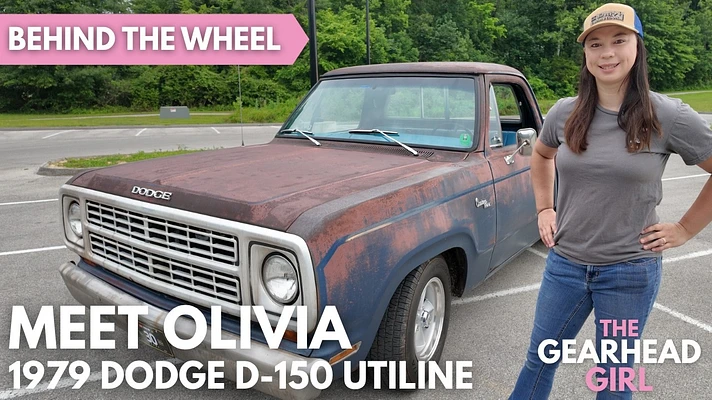
Olivia, 1979 Dodge D-150 Utiline

Olivia, 1979 Dodge D-150 Utiline

Ever since I was a little girl, I’ve wanted a Dodge stepside pickup truck and dreamt of having a Li’l Red Express or a Warlock. So, while cruising Facebook Marketplace during one weekend back in August 2023, I came across a patina’d 1979 Dodge D-150 Utiline in Virginia. I showed it to my husband, who was sitting next to me on the couch at the time, and also sent the listing to my best friend, who responded saying that she and her husband could go check it out for me. And so they did — that afternoon. Once I got the report on the truck’s condition, I told my husband I was buying it, reserved a one-way car rental for the following Saturday, drove out, met my best friend and her husband, and picked up the truck. After spending the night at their house, I got an early start and drove it seven or so hours home during a really nice heat wave. 

Since then, Olivia (named after the main character in Fringe, one of my favorite TV shows) has gotten a new flywheel, throwout bearing, oil pan, oil pump, and window seals. I also put a new rear bumper on her, but I eventually decided I didn’t like how it looked and took it off. 

Olivia’s still a little bit of a work in progress. I have plans to finish adding some trim onto her (on the rear window, for example), replace the door locks since the driver’s one doesn’t work, refinish the rusty exhaust manifolds, and craft a new shifter boot as the old one and its rubber replacement tore. 

Serenity Keeps Doing Her Thing

Serenity, 2013 Subaru BRZ

Serenity, 2013 Subaru BRZ

My 2013 Subaru BRZ daily driver, Serenity, hasn’t had any major issues. I changed her transmission and differential fluids several months ago, and she got a multiyear ceramic coating back in 2023. Besides a piece of trim that is coming loose on the center console for some reason, she’s been pretty trouble-free and reliable. 

So, what’s next? Well, besides getting some more work done on these four-wheeled children of mine, I’m not sure. There are a couple of car purchases that I’d like to do, perhaps by next winter (such as a new daily for doing truck things and for when there’s snow on the ground), but we will have to see if the right deal comes along. In the meantime, stay tuned for the automotive shenaniganry I have planned for this year. I hope to have updates every couple of weeks or so — I promise this time.

Watch the YouTube Video Here